The Reckoning
China’s Companies have arrived. Neither side is fully ready.

Overture

Chinese companies are coming to Europe and the United States. In many sectors, they have already arrived. The debate consuming boardrooms and legislatures — can they be stopped? — is the wrong question, or at least an incomplete one. Two better questions deserve to be asked simultaneously, and they point in different directions.
The first is addressed to the West: How did we arrive here, what is actually coming, and what should Western companies and governments do about it?
The second is addressed to the Chinese companies now arriving at the gate: What will it actually take to win?
Both questions are harder than they appear. And the answers to each illuminate the other. This essay addresses them in turn.
— MOVEMENT I —
Chinese Companies Are Coming: How Should the West Respond?
How the West Built Its Own Challenger
The uncomfortable truth that rarely surfaces in Western boardrooms is this: the competitive threat from Chinese companies is not something that happened to the West. It is, in significant part, something the West built.
For three decades, Western corporations pursued a strategy that was rational quarter by quarter and cumulatively self-defeating: the systematic transfer of manufacturing capacity, operational know-how, engineering discipline, and indirect market access into China, in exchange for lower costs, higher margins, and short-term shareholder returns. The logic at each decision point was sound. The strategic consequence, accumulated across hundreds of companies and thousands of supply chain decisions, was the construction of the very competitors now arriving at the door.
This is not a story of naïvety alone. Capital behaves as capital does: it moves toward the highest return. In China, for more than two decades, the returns were extraordinary. Lower labor costs, disciplined workforces, government incentives for foreign direct investment, and an enormous untapped consumer market created conditions that Western CFOs could not responsibly ignore. “Capital is a coward” — it does not ask civilizational questions. It asks return questions. For decades, the answers pointed consistently east.
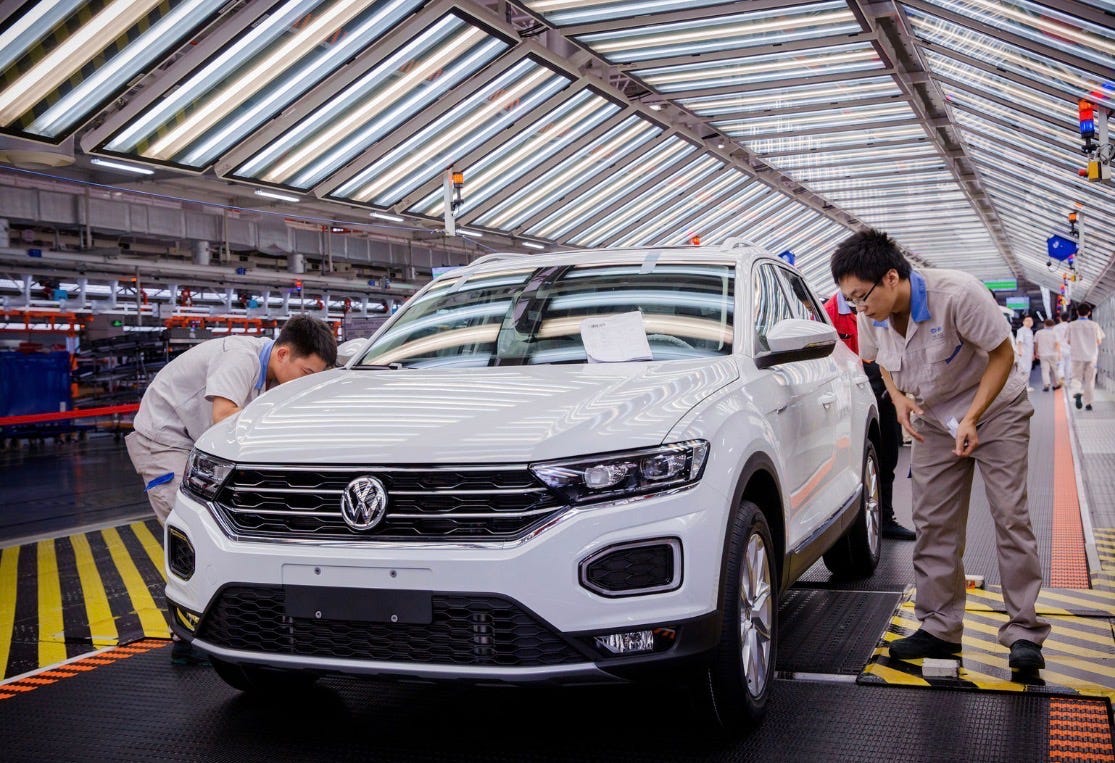
What made this capital migration different from normal globalization dynamics was what traveled with it. Not just manufacturing contracts, but quality systems. Not just product specifications, but engineering discipline. Not just market access, but a structured education in how Western supply chains function, what Western customers require, and how global commercial relationships are built and maintained. Entire generations of Chinese engineers, managers, and entrepreneurs received their most consequential business education inside the factories, joint ventures, and supplier networks of Western multinationals. The textbook was written in the West. The students were Chinese. The exam results are arriving now.
China understood something that many Western executives did not, or chose not to: globalization was not just about trade flows. It was about capability accumulation. Western firms optimized for quarterly financial extraction. Chinese firms — often with patient government backing, long institutional time horizons, and a strategic culture that measures success in decades rather than quarters — optimized for industrial learning. The asymmetry compounded with each passing year.
In many cases, Western CEOs were handsomely rewarded for “winning China” — for establishing the joint venture, signing the supply agreement, opening the factory. In doing so, they were often unintentionally training the future competitors that would eventually challenge their own global businesses. The assumption underwriting all of this — that economic liberalization would converge with democratic liberalism, making China more Western over time — now looks not merely wrong but historically naïve.

The point is not moral recrimination. Capital pursuing returns is not a failure of judgment but a structural consequence of the incentive systems Western corporations operate within. The point is clarity of diagnosis: the competitive pressure now bearing down on Western industries is partly an artifact of decisions that made complete sense at the time. Understanding that history matters because it reframes the response. This is not an external aggression to be repelled by legislation alone. It is, in part, a consequence of structural incentives that need to be redesigned.
What Is Actually Arriving
There is a phenomenon in Chinese commercial culture that has no direct Western equivalent, and that has produced some of the most distinctive and misunderstood features of the competitive landscape now going global.
When a business succeeds visibly in China, others follow — not gradually, not cautiously, but in concentrated waves. One entrepreneur opens a pearl store and thrives. Within months, an entire street, then an entire district, becomes pearl stores. The same pattern repeats across turbochargers, switchgear, socks, optical equipment, control systems, furniture, construction materials, and consumer electronics. Chinese entrepreneurs rally around proven commercial winners with a speed and density that can look, from the outside, like irrational imitation. What it actually produces is something more consequential: concentrated industrial ecosystems of extraordinary depth, scale, and competitive refinement.
The mechanism works through attrition. Intense localized competition destroys individual margins and eliminates the weakest entrants, but simultaneously creates something that no distributed market logic generates as efficiently — entire supply chains, manufacturing communities, specialist knowledge networks, and logistics systems optimized to a single product category through years of brutal selection. The winners that emerge from this process are not merely competent. They are the survivors of the most rigorous competitive selection mechanism in modern industrial history. Western observers who see only the chaos of imitation miss the infrastructure it creates. What looks like a street of pearl stores is also the development of the world’s most efficient pearl supply chain. That efficiency eventually becomes an export.
Before assessing the scale of what is arriving, precision about definitions matters. “Global” is a term applied to Chinese companies loosely and inconsistently. Selling products internationally is not the same as becoming a genuinely global company. A more useful taxonomy distinguishes three categories:
Tier 1 Global Chinese Companies generate more than 50 percent of their revenue outside China. This group remains relatively small but produces the most visible competitive disruption — BYD’s export operations, DJI’s domination of the commercial drone market, SHEIN’s compression of fast fashion economics, Temu’s entry into Western e-commerce.
Tier 2 Emerging Globalizers generate between 30 and 50 percent of revenue offshore. This category is analytically underappreciated. The companies in it have genuine international traction but organizational models still transitioning from domestic to global. Over the next twenty years, this middle tier may represent the more significant wave of competitive pressure — not because any single company within it is as formidable as a Tier 1 player, but because of its collective scale and forward momentum.
Export-National Champions have substantial export volumes but operating models, leadership structures, and strategic dependencies that remain overwhelmingly China-centric. They sell globally but are not yet organized globally. They are candidates for the tier above, not members of it. They usually lack global branding power but produce for many famous brands. Furniture and construction materials are good examples.
The Tier 1 companies already visible are formidable. BYD has surpassed Tesla in quarterly global EV sales, controls its own chip design, manufactures its own batteries, and has a cost structure that European automakers are struggling to comprehend, let alone match. CATL holds roughly 37 percent of global EV battery supply and counts Volkswagen, BMW, Ford, and Tesla among its customers. The global transition to electric mobility runs, in significant part, through one company’s factories in Fujian. DJI owns the commercial drone market so thoroughly that American attempts to legislate it out of US airspace keep colliding with the inconvenient reality that there is no competitive alternative. SHEIN has compressed the design-to-shelf cycle from months to days, rewriting fast fashion economics in ways that Zara and H&M cannot replicate. Temu’s entry into Western e-commerce produced user acquisition numbers that forced legacy platforms to reconsider their assumptions about price sensitivity.

The supply chain dimension extends deeper than the visible products. Data centers — the physical backbone of AI, cloud computing, and digital services — depend heavily on servers, networking equipment, cooling systems, and power management infrastructure, much of which is manufactured in China or by Chinese companies. Western governments and hyperscalers are grappling with a paradox they have not resolved: building AI infrastructure intended to reduce dependence on Chinese technology while relying on Chinese supply chains to build it. This tension will not resolve cleanly or quickly.
These are not state instruments. They are companies that earned their position in the most unforgiving commercial environment on earth. The question is whether that excellence translates, and what it will take for it to do so.
Why They’re Coming Now: The Push Behind the Push
The conventional narrative frames Chinese globalization as a strategic offensive — an expansionist push engineered in Beijing. The reality is more complex, and more instructive. Many of the Chinese companies now entering Western markets are not expanding purely from a position of domestic strength. They are also responding to domestic conditions that make international expansion a commercial necessity.
China’s domestic market is ferociously competitive and, in many sectors, structurally margin-destructive. The same crucible that forged these companies’ capabilities also compressed their profitability. The EV market is the most visible example: China now hosts over a hundred electric vehicle manufacturers competing for domestic market share, and the resulting price wars have driven margins to levels that make domestic-only profitability nearly unsustainable. BYD’s globalization is not merely a story of ambition. It is also a response to brutal domestic economics. The same pattern appears in solar panels, where successive rounds of capacity expansion have made export-or-die a structural imperative for the sector’s survivors. In consumer electronics, margins have been competed away by the pearl-store dynamics described above. In batteries, in industrial equipment, in control systems, the pattern repeats: companies achieve world-class capability, face domestic price destruction, and discover that Western markets offer something the home market cannot — pricing power, less saturated competitive fields, and the foreign currency earnings that transform a company’s financial profile. For many, going global is not optional. It is the route to profitability.
The overcapacity dynamic intensifies this pressure. Chinese industrial systems are oriented toward scale. Scale generates supply that routinely exceeds domestic demand. That surplus must find exits, and Western markets — with their higher price ceilings and less saturated competitive landscapes — are the logical destination. This is not strategic conspiracy. It is the near-gravitational consequence of an industrial model built for volume, and of the perpetual-motion logic of the pearl store applied at national scale.
The geopolitical dimension adds a third force. Chinese government policy has moved from tolerating outbound investment to actively encouraging it. Companies that build genuine international market positions reduce China’s dependence on any single geopolitical relationship and diversify the country’s economic exposure. The alignment of commercial incentive and state interest is a powerful accelerant.
Western incumbents who frame all of this as purely strategic aggression misread the underlying economics — and calibrate their response accordingly wrong. Understanding the commercial logic driving the other side is not a concession. It is the precondition for a response that actually works.
The External Barriers Are Real. They Are Not the Main Story.
Geopolitics, tariffs, regulatory complexity, forced labor legislation, the closure of the acquisition route: these are genuine headwinds and deserve to be named clearly.
CFIUS and its European equivalents have effectively closed the acquisition path that was once the fastest route to Western market entry, local talent, and brand credibility. Organic build is now the primary available route. It is slower, more expensive, and requires exactly the organizational capabilities Chinese companies are still developing. The US Uyghur Forced Labor Prevention Act’s rebuttable presumption structure means goods with Xinjiang inputs are detained at ports unless proven otherwise — a real market access problem for companies in textiles, electronics, solar, and polysilicon. The Huawei and TikTok precedents have established that product quality provides no protection once geopolitical momentum reaches critical mass.
These barriers will shape which sectors are accessible and which entry paths are viable. They require serious geopolitical risk management as a core strategic discipline — not a government affairs function, but something that shapes product decisions, data architecture, and partnership choices from day one.
But they do not answer the fundamental question. Plenty of Chinese companies will navigate the external environment competently and still fail to build genuine market presence. The chief reason will be internal more than it will be external.
The Role of Government: Industrial Policy, Not Just Walls
The corporate strategy conversation in this article has a necessary counterpart that is largely missing from the policy debate: what should Western governments actually do? The answer is not primarily about walls. Tariffs, CFIUS screening, forced labor legislation, and technology export controls are legitimate instruments. But they are intervals, not strategies. They buy time. The critical question — the one that determines whether that time is used productively — is what industrial policy fills the space they create.
China’s own development trajectory offers the most instructive model, and Western governments would do well to study it honestly rather than simply react to its outputs. China’s successive five-year plans were not primarily about keeping foreign competitors out. They were about using the interval of protection to build genuine domestic capability — directing government support into specific industries, incentivizing local innovation, and progressively raising the sophistication level required of domestic companies. The walls were temporary scaffolding. The building was the point. State Capitalism was working at full speed.
The nuance on incentives is important and almost entirely absent from Western policy debates. Western multinationals operating inside China — including companies like Honeywell — regularly received substantial government incentives for genuine research and development activity. Tax credits worth millions of dollars annually were available to foreign companies that invested in real R&D, produced genuine IP, and created local innovation capacity. The incentives were not exclusionary. They were conditional — on genuine investment, genuine innovation, genuine capability-building. The difference was not that China subsidized its companies while Western multinationals competed without support. The difference was that China’s policy architecture was designed to produce capability accumulation, while Western policy frameworks optimized, in practice, for short-term consumer welfare. Public policy shapes behavior. That cuts both ways, and the lesson is available to Western governments willing to draw it.
The productive Western policy agenda is not defensive. It is constructive. Incentivize advanced manufacturing that cannot easily be replicated by lower-cost competitors. Fund R&D at the frontier — in AI, advanced materials, next-generation energy systems — with the urgency that strategic importance demands. Accelerate automation and robotics in domestic industry, which is the only durable structural response to labor cost differentials. Create the conditions for private capital to move into strategic sectors rather than ceding them by default to patient state-backed competitors.
The critical discipline is sequencing. Protection without capability-building simply delays the reckoning. The walls will come down — through negotiation, WTO mechanisms, the political limits of consumer tolerance for higher prices. When they do, industries that used the interval to genuinely strengthen will emerge more competitive. Industries that used it to avoid the uncomfortable internal changes that competition demands will face a worse version of the same problem at a later date. Government policy can create the conditions for the first outcome or inadvertently enable the second. The design choices made now will determine which.
What Western Companies Must Do
The competitive arrival of this generation of Chinese companies is not a problem that tariffs will solve, legislation will prevent, or time will dissolve. It is a structural shift in the global competitive landscape, and Western companies that treat it as a temporary political situation rather than a permanent commercial reality are making a strategic error that will be expensive to correct.
Start with honest assessment. The instinct to dismiss Chinese competitors as cheap, state-subsidized, or IP-dependent is both outdated and dangerous. Some of that description was accurate twenty years ago. In the sectors leading the current wave — EVs, batteries, consumer electronics, fast fashion, industrial equipment — it is simply wrong. BYD is not winning on price alone. CATL is not dominant because of subsidies. DJI does not own the drone market because of dumping. These companies are winning because they are genuinely better at certain things. Western incumbents who cannot say clearly what those things are, and why, are not ready to compete.
Do not wait for the wall to protect you. Tariffs and investment screening are buying time, not building competitiveness. The companies that use this window to genuinely improve — on cost discipline, on product iteration speed, on supply chain efficiency — will emerge stronger when the political environment shifts. The companies that use it to avoid the uncomfortable internal changes that competition requires will find themselves in a worse position when protection erodes. The wall is not a strategy. It is an interval.
Recognize your real moats and invest in them aggressively. Western incumbents have genuine competitive advantages that need to be named clearly rather than assumed. The most durable and underappreciated is the channel and partner ecosystem built over decades — distributor networks, dealer relationships, value-added resellers, systems integrators, retailer partnerships, healthcare GPOs, enterprise implementation partners. These are deeply embedded commercial architectures built on personal trust, shared history, and mutual dependency, constructed over decades and impossible to replicate quickly regardless of product quality or price. A Chinese EV manufacturer can build a compelling vehicle. It cannot build, in five years, the dealer network, service infrastructure, and customer relationship architecture that gives an incumbent access to every market in a country.
If you have already globalized through China, you have a structural head start. Western multinationals that built genuine operations in China — with local leadership, local R&D, locally adapted cost structures, and the organizational discipline to compete in the world’s most demanding market — have already done this hard work once. They understand from the inside what it costs to build in a hyper-competitive, fast-moving environment where margins are thin and the pace of change is relentless. That China DNA is a competitive asset most peers do not possess. Companies that recognize it and deploy it deliberately — rather than treating their China experience as a regional sideshow — will find themselves better equipped than incumbents who built only for home markets.
Compete on what Chinese companies cannot easily replicate, yet. Regulatory relationships built over decades in heavily governed sectors — financial services, healthcare, defense-adjacent industries — represent real barriers to entry that Chinese competitors will take years to build. Brand trust in categories where data sovereignty and privacy are purchasing criteria is a genuine competitive advantage that Chinese companies will struggle to establish until they resolve their data architecture credibility problem. These moats are real. They are also not permanent.
Learn from the competition rather than only defending against it. Chinese companies bring capabilities that Western incumbents need to honestly study. The velocity of product iteration that BYD brings to vehicle software, that Chinese consumer electronics companies bring to hardware development cycles, is a disciplined operational capability, not a cultural accident. Western companies that study how their Chinese competitors move as fast as they do, and honestly assess where their own processes are slower than necessary, will extract more competitive intelligence than any market research report provides.
The honest conclusion is uncomfortable: some Western incumbents in some sectors will not survive this wave regardless of what they do. The economics of certain industries have shifted in ways that management effort alone cannot reverse. The productive response is not denial but adaptation — finding the segments, customer relationships, and value propositions where a Western competitor can genuinely win, and concentrating resources there with discipline.
The Bigger Prize: The Next Two Billion
The competitive stakes in this story extend far beyond the defense of Western home markets. The same forces reshaping competition in Europe and the United States are also determining who will win the largest commercial opportunity of the next two decades: the emerging middle class across Africa, Southeast Asia, India, and Latin America.
Over the next ten to fifteen years, one to two billion people will rise into a consuming middle class. China itself lived this transformation over three decades — the fastest and largest expansion of middle-class purchasing power in human history. The next wave is now underway: urban India, coastal West Africa, Vietnam, Indonesia, the Philippines, Colombia, Brazil, Mexico. These markets will need to be serviced with goods and services. The companies that reach them first, at the right cost structure, with the right product adaptations, will define entire industry categories for a generation.
Chinese companies have prepared themselves well for exactly this. They operate at cost structures Western multinationals cannot easily replicate. They have experience adapting products for price-sensitive, infrastructure-constrained markets. They have been building relationships and operational footholds across Africa and Southeast Asia for two decades — initially through state-backed infrastructure projects, increasingly through commercial market-building. They are ahead.
Here is where the argument closes its loop. Western multinationals that genuinely learn to compete with Chinese companies — on cost structure, on speed of iteration, on organizational adaptability, on the willingness to build locally rather than headquarters-out — will not only defend their home markets. They will also build the capabilities required to compete for the next two billion consumers. Welcoming the Chinese competitor, studying it seriously, and allowing it to force genuine organizational transformation is not comfortable. It is also not intuitive. But it may be the most strategically important choice a Western company can make right now — not because it is easy, but because the alternative is to remain unprepared for a world that is arriving regardless.
— MOVEMENT II —
Chinese Companies Are Coming: Will They Win? And How?
The Workarounds That Won’t Work
Faced with external pressure, Chinese companies have developed strategies designed to soften their landing in Western markets. Each is rational. None is a substitute for the harder organizational transformation that winning actually requires.
The Singapore gambit. Restructure through a Singapore or Dubai holding company and enter Western markets as a regionally-headquartered company rather than a Chinese one. This has genuine value when it reflects real organizational change: actual relocation of decision-making authority, genuine separation of governance, non-Chinese boards with real power. It is theater when it is a mailing address on top of an organization that still makes every meaningful decision in Mandarin through networks rooted in Beijing. Regulators, business partners, and the press are sophisticated enough to ask where decisions are actually made, in which language, and by whom. The DNA of an organization is not a legal structure.
Joint ventures, licensing, co-branding, and alliances. The appeal is obvious: borrowed credibility, shared regulatory risk, faster access to distribution. This will be the dominant entry mode for many Chinese companies initially. But three decades of MNC joint ventures in China have produced consistent cautionary lessons: misaligned time horizons, disputes about customer ownership, technology transfer anxieties, governance ambiguities that create paralysis at critical moments. The reverse will not be simpler. Western partners will carry anxiety about IP, data flows, and what partnership actually means when strategic interests diverge. Most JVs in this direction will underperform. Some will fail instructively.
The token foreigner. The Western name in the org chart. The non-Chinese face in the press release. Given no real authority, no genuine decision-making power, no seat in the rooms where things actually get decided. Chinese social media mocks this practice openly. Sophisticated Western markets recognize it immediately. It produces neither organizational benefit nor reputational credibility.
The Data Trap — And Its Mirror
The thorniest issue, and the one most capable of ending a Western market position regardless of everything else, is data.
Any Chinese company operating software platforms, connected devices, cloud services, or AI applications in Western markets faces an unavoidable question: where does data live, who can access it, and under what legal obligations? China’s National Intelligence Law requires organizations to cooperate with state intelligence work upon request. That legal structure creates a concern for Western governments and enterprises that cannot be waived by contract or resolved by reassurance. It requires technical architecture: genuinely firewalled data systems, verifiable local residency, third-party auditing with real independence.
The irony is exact and worth stating. Western companies operating in China face nearly identical requirements. American cloud providers cannot offer certain services in China without local data localization structures that effectively provide Chinese authorities access. Both systems have produced conditions in which foreign companies face legal obligations to host governments that their home governments find intolerable. This symmetry should temper the moral framing of the debate. It does not reduce the practical requirement for Chinese companies entering Western markets: build verifiable data sovereignty into Western operations from the beginning, as a non-negotiable design requirement. Not as a retrofit. Not as a concession. As table stakes. Companies that do not will face their TikTok moment.
The Real Barrier: Leadership and the Deeper Organizational DNA
Here is the argument that deserves to be at the center of this conversation, and largely is not.
The companies that will win in Western markets are not the ones with the best technology or the lowest costs, though they will need both. They are the ones that solve the organizational problem: building genuinely local leadership and actually trusting it with consequential authority.
The default playbook is clear, familiar, and insufficient. Send home-country leaders abroad — trusted, linguistically comfortable, embedded in the networks through which real decisions flow. But they arrive with a headquarters-out worldview that cannot build authentic local market roots. Supplement with overseas Chinese professionals who bridge some cultural gaps but rarely the decisive ones. And add, for optics, the token Western face that signals global ambition to no one paying attention.
The deeper problem is structural. China is one of the world’s most homogeneous large societies. Its business culture is profoundly relationship-centered. Guanxi — the architecture of trust built through shared language, shared cultural references, educational ties, and years of accumulated personal familiarity — is not a buzzword. It is a real operating system.
But reducing the organizational challenge to guanxi alone understates it, and risks falling into the trap many Western analysts make of collapsing all Chinese organizational behavior into a single concept. Guanxi does not explain Chinese execution intensity. It does not explain Chinese strategic adaptability. The full organizational operating system that high-performing Chinese companies have built is more sophisticated than any single term captures, and two of its most consequential — and least replicable — elements are rarely named in Western discussions.
The first is Jiāzhǎngshì Lǐngdǎo (家长式领导) — a form of paternalistic authority in which senior leaders assume responsibility not merely for performance outcomes but for the broader welfare architecture of employees’ lives. Housing, family health, personal milestones: all fall within the orbit of the effective Chinese leader’s attention. The resulting exchange — comprehensive protection and personal investment in return for organizational loyalty that can be total — creates cohesion and execution intensity during periods of rapid growth or crisis that Western organizations, operating on professionally distanced management norms, rarely match. The loyalty is not purchased. It is earned through demonstrated care. The performance it generates is not compliance. It is commitment.
The second is Shěnshí Duóshì (审时度势) — a form of anticipatory execution: the ability to read the direction of political, regulatory, and market change before it is formally articulated, and to mobilize organizational action at exceptional speed. Western firms often experience this as recklessness — the Chinese competitor building the high-rise before the architectural drawings are complete. Inside China’s competitive and regulatory system, it frequently functions as decisive adaptive advantage. The organizational bias is toward momentum first, optimization second. By the time a Western competitor has completed its due diligence process, the Chinese firm has already broken ground.
These are not personality traits. They are embedded organizational capacities, shaped by the specific competitive and institutional environment in which these companies were formed. Chinese competitive strength is not just guanxi. It is a deeper organizational operating system combining relational authority, strategic sensing, adaptive execution, and embedded trust architectures. Extending genuine decision-making authority to someone who exists outside this system runs against a coherent operating logic that works extraordinarily well inside China and becomes a structural liability when applied unchanged to markets it was not built for. This is a diagnosis, not a criticism.
The Other Side of the Hiring Problem
The challenge runs in both directions, and this half is almost never discussed.
Will excellent Western talent actually join Chinese companies? The career calculus for a senior German automotive executive or a respected American enterprise software leader considering a Chinese employer is real and not easily dismissed. The geopolitical stigma is portable — it follows a career across subsequent moves. And beneath the compensation and the title is the question every capable candidate is actually asking: is the authority real?
The most talented candidates for these roles have usually seen the dynamic before: a senior local hire who discovers that meaningful decisions are made in a language they don’t speak, through networks they cannot access, by people who were never in the job description. They are not going to take the career risk for a role that turns out to be advisory in practice.
What these candidates often do not fully anticipate — and what makes the challenge more intractable than it first appears — is the existence of informal decision architectures operating in parallel to the formal organizational chart. Real influence in many Chinese firms flows through relationship networks, founder proximity, political trust, historical loyalties, and internal alliances that are largely invisible to outsiders. Decisions appear agreed in formal settings, then shift or stall elsewhere — in conversations the Western executive was not part of, mediated by relationships they do not have. Even highly capable Mandarin-speaking Western executives often struggle to fully access these structures. The result is not merely frustration but operational ineffectiveness: a leader who is formally empowered but practically peripheral. Understanding the visible organization is often insufficient. The real organization sits partially underneath it.
This creates a compounding problem. The companies most in need of excellent Western leadership are often the ones least organizationally ready to provide the conditions that would attract it. Breaking this cycle requires something specific: a CEO who makes the commitment visibly and personally, and early hires who are demonstrably given real authority in ways the market for talent can observe. The first two or three hires of this kind are the hardest to make and the most important. They are the signal.
The Mirror: What Western Companies Learned in China
This is not a new problem. It is the same problem, reversed. And I watched it unfold from the inside.
In 2005, I presented to Honeywell’s global leadership what I called the “March of the Red Army”: a systematic mapping of Chinese competitors rising from the bottom of the market pyramid. These were companies born in back-street workshops and industrial parks, producing what looked, on the surface, like cheap copies of ours. Shanzhai, the Chinese vernacular for this phenomenon, carried a dismissive connotation at headquarters, and that dismissiveness was nearly universal. The prevailing view was confident and wrong: these were corrupt, cash-burning copycats who would collapse under their own poor quality and IP exposure. Not worth serious strategic attention.
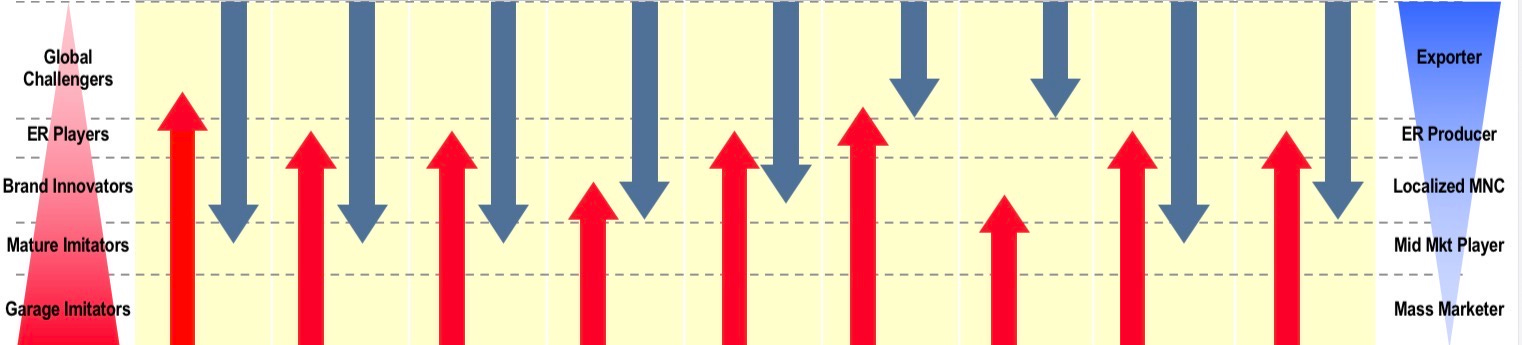
We pushed back with data. We had done the work on the ground, tracking the handful of companies in each product category that were not merely copying but genuinely learning, iterating, improving, and beginning to compete on dimensions that mattered to Chinese customers: price, local features, serviceability, local relationships, and speed of response. Swimming in a sea of thousands of imitators were a smaller number of companies that were quietly becoming real. We made headquarters see them — not as a generic threat but as specific competitors with specific strengths in specific markets.
That recognition led directly to what became Honeywell’s “East for East” strategy: building locally for local markets, with local leadership, local R&D, and local end-to-end decision-making authority. Ultimately we articulated our ambition internally as “Becoming the Chinese Competitor.” Not competing against Chinese companies as a foreign multinational defending its position, but competing as a genuine local player who happened to have global technology behind it. We learned to respect these companies, study them, and beat them on their own terms — with local pricing logic, local service architectures, locally adapted features, and local relationships that headquarters-driven strategies could never build.
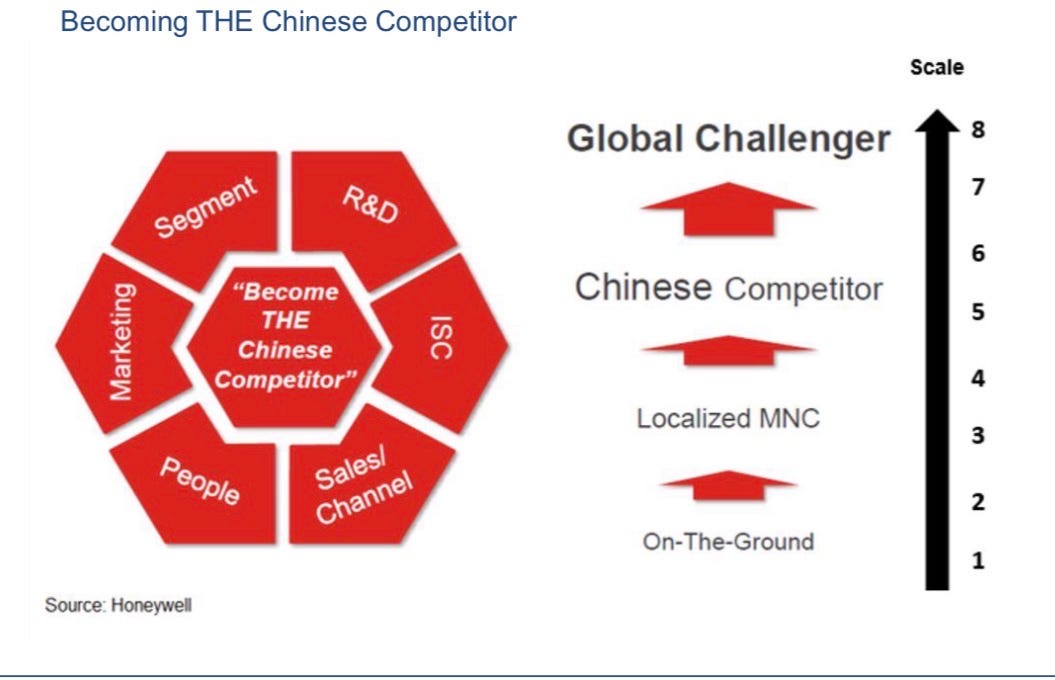
The results were not abstract. China became not just Honeywell’s fastest-growing and largest business outside the United States, but one of its most profitable, genuinely accretive to global margins. That outcome was inseparable from the decision, made years earlier, to take the competition seriously before anyone at the center thought it necessary.
The lesson is directly transferable, and the direction of travel has reversed. The companies we were tracking in 2005 are the companies now arriving in Europe and the United States. The Western executives who dismiss them today as cost-competitive but technologically shallow, or as state-backed rather than genuinely innovative, are making precisely the mistake that multinational headquarters were making twenty years ago. The data on the ground tells a different story. The question is whether Western incumbents will read it in time.
KFC became one of the most successful restaurant brands in Chinese history not by replicating its American model but by letting Chinese leaders genuinely reinvent it: local menu innovation, local management, local supply chains, driven by people with the authority and mandate to act on what the market required. The result looked more like a Chinese company with an American parent than an American company operating in China. The lesson from both cases, and from every genuine success story in Western companies’ China expansion, is consistent: localization of leadership is not a cultural accommodation. It is the commercial strategy. Everything else is implementation.
American and European companies had a structural advantage in making this leap. They come from immigrant societies where the definition of “one of us” is broad, porous, and at their best, genuinely meritocratic across cultural lines. For Chinese companies, this is a harder ask. Not impossible, but harder. Chinese society is largely homogeneous and has had little historical need to develop the organizational reflex for integrating outsiders into genuine positions of trust. Building it across real cultural distance requires conscious design, CEO sponsorship, and patience measured in years rather than quarters.
What the Winners Will Actually Look Like
The profile of Chinese companies that will genuinely win in Western markets is becoming discernible, and it is not what most people expect.
Their CEOs will have spent real time in Western markets — not on roadshows, but the kind of sustained engagement that builds genuine intuition and genuine relationships. They will have made the localization of leadership a personal agenda item with personal accountability attached. Their senior Western hires will be in the rooms where consequential decisions are made, with real P&L ownership, real authority over market strategy, and career trajectories that do not require relocating to China.
The data question will be resolved technically and verifiably, not rhetorically. Geopolitical risk will be managed as a strategic discipline from day one, not a crisis response after the fact. Over time, they will have built something harder to replicate than any product advantage: a reputation as employers where excellent Western professionals can build real careers with real authority.
When this combination comes together, these companies will be formidable in a way that existing Chinese market entrants are not. They will combine the cost efficiency and technological depth that Western incumbents cannot match with the market embeddedness and local credibility that previous Chinese entrants never achieved.
There is a strategic dimension to all of this that Western observers consistently misread — and a metaphor from Chinese intellectual tradition that clarifies it with unusual precision.
Western strategic thinking defaults to the logic of chess: decisive confrontation, territorial capture, and ultimately the removal of the opposing king. Victory is binary, achieved through direct dominance. China’s strategic tradition is closer to Wei Qi — known in the West as Go. Wei Qi does not seek the opponent’s destruction. It seeks positional advantage, patient encirclement, the gradual accumulation of influence across the board until outcomes become structurally inevitable — without a single decisive confrontation. The goal is not to kill the king. It is to make one’s own position so advantageous that the outcome is no longer in question.

This distinction matters practically. Many Western observers interpret Chinese commercial expansion as an attempt at outright dominance — at winning in the zero-sum sense they understand from chess. They are often mistaken. What they are observing more accurately is the patient construction of supply chain leverage, market optionality, customer dependency, and strategic positioning across multiple theaters simultaneously. The Chinese competitor is not necessarily trying to defeat you. It may be surrounding the board in ways you have not noticed yet. By the time the encirclement is visible, the question of who holds the structural advantage may already be settled.
Finally: at some point, the most globally successful Chinese companies will need to develop a class of leadership that does not yet widely exist. Not Western executives with Mandarin fluency alone — though language helps. Not Chinese executives with Western market experience alone — though that matters too. What the moment ultimately requires is something rarer: leaders who are genuinely credible inside Chinese trust architectures while remaining genuinely credible in Western commercial and cultural contexts. Leaders who can navigate the shadow hierarchy and the formal org chart simultaneously. Leaders who can translate not just language but the deeper operating systems of two different civilizational business models — in both directions, in real time.
This is the real scarcity. The executives who achieve it will be disproportionately valuable strategic assets to whoever they work for — whether that is a Chinese company trying to win in the West or a Western company competing in a genuinely global landscape.
One final asymmetry is worth naming. American and European systems remain substantially more open to integrating foreign executives into positions of real authority than Chinese systems currently are. That structural imbalance still tilts the playing field. Whether it remains permanent — whether the organizational evolution required to close that gap is achievable within the timeframe that competitive pressure demands — is one of the most important unanswered questions in global business.
The Chinese companies that figure this out will not merely enter Western markets.
They will shape them.
Shane Tedjarati spent more than two decades building and leading operations at the intersection of Chinese and global markets, including growing Honeywell’s China business into the company’s second-largest country operation. He is Founder and CEO of Tribridge Group and a Visiting Scholar at UC Berkeley.